Oolong tea is a partly oxidized tea made from the same plant as green and black tea, Camellia sinensis. Its leaves are withered, bruised and allowed to oxidize only part of the way before they are heated to stop the process, so oolong can taste anywhere from light, floral and buttery to dark, roasted and honeyed. It comes mainly from China’s Fujian province and from Taiwan, and it is usually brewed several times from the same leaves.
Key facts
- Oolong is semi-oxidized, anywhere from roughly 8% to 85%, which places it between green and black tea.
- The Chinese name is usually translated as “black dragon” or “dark dragon” tea.
- Key regions: the Wuyi Mountains and Anxi County in Fujian, and the mountains of central Taiwan.
- Brew with water around 80–95 °C (180–205 °F); greener oolongs like the cooler end, roasted ones the hotter end.
- Good oolong can be steeped several times, and the flavor shifts with each infusion.
How is oolong different from green and black tea?
All true teas come from one plant. What separates them is processing, especially oxidation, the browning reaction that starts when leaf cells are bruised and exposed to air. Green tea is heated soon after picking to stop oxidation almost entirely. Black tea is allowed to oxidize fully. Oolong sits in between: the encyclopedia entry on oolong puts its oxidation at between about 8% and 85%, depending on the style and the producer.
Producers wither the leaves, often in sun, then toss or roll them to bruise the edges, let them oxidize, and finally fire them to fix the level they want. Many oolongs are also roasted afterwards over charcoal or in ovens, which adds toasty, caramel and sometimes smoky notes. Those steps take careful timing, which is one reason oolong is often more expensive than everyday black tea. Our comparison of tea types shows where oolong sits next to white, green, black and pu-erh.
| Green tea | Oolong | Black tea | |
|---|---|---|---|
| Oxidation | Minimal | Partial (about 8–85%) | Full |
| Typical flavor | Grassy, vegetal, fresh | Floral and creamy to roasted and fruity | Malty, brisk, bold |
| Leaf look | Green, flat or needle-like | Rolled balls or long twisted leaves, green to dark brown | Dark, small or broken |
| Water temperature | About 70–80 °C | About 80–95 °C | Near boiling |
| Re-steeping | Sometimes | Usually several times | Rarely |
What does oolong tea taste like?
Because oxidation and roasting vary so much, oolong is less one flavor than a family. Lightly oxidized, green-style oolongs taste floral and creamy, sometimes with a buttery texture. Medium oolongs bring stone fruit and honey. Heavily oxidized and roasted oolongs taste of toasted grain, dark fruit, cocoa and mineral notes. Most good oolongs share a smooth, rounded body with little bitterness when brewed correctly.
What are the main types of oolong?
- Tieguanyin (Iron Goddess of Mercy). From Anxi County in Fujian. Modern versions are often green, floral and tightly rolled; traditional versions are roasted and darker.
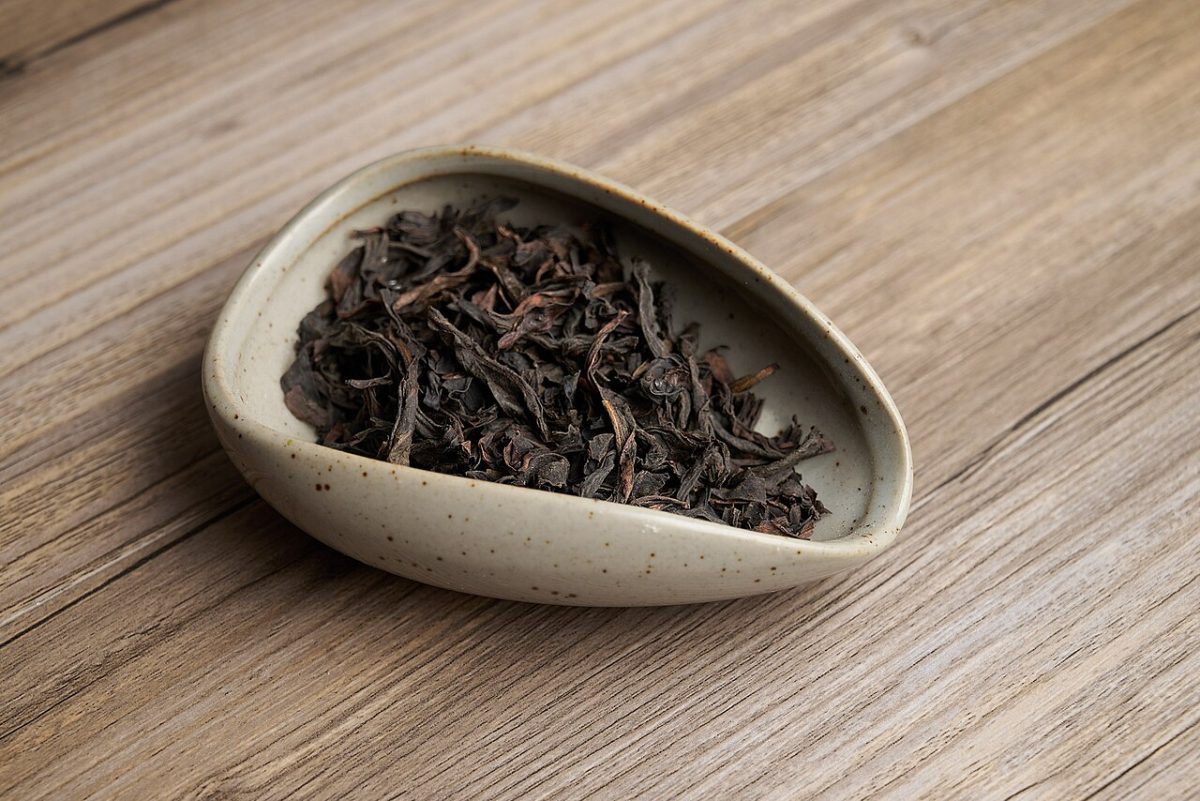
- Wuyi rock teas (yancha). From the Wuyi Mountains in northern Fujian, with long, dark, twisted leaves and a roasted, mineral character. Da Hong Pao (Big Red Robe) is the best-known name.
- Dong Ding. A Taiwanese oolong, tightly rolled, usually medium-oxidized and lightly roasted, with a nutty, sweet flavor.
- Taiwanese high-mountain oolong (gaoshan). Grown at high elevation in areas such as Alishan, lightly oxidized, floral and sweet with low astringency.
- Oriental Beauty (Dongfang Meiren). A heavily oxidized Taiwanese oolong made from leaves bitten by small insects called leafhoppers, which gives it a honeyed, muscat-like aroma.
- Milk oolong. A Taiwanese style prized for its creamy aroma. Some versions are naturally creamy; cheaper ones are flavored, so check the label if you want an unflavored tea.
How do you brew oolong tea?
You can brew oolong in a regular teapot or in the traditional gongfu style with a small pot or lidded bowl (gaiwan). Western-style brewing is simpler; gongfu brewing uses more leaf and short steeps to show how the flavor changes from one infusion to the next. Our step-by-step guide to brewing loose leaf tea covers the basics of water and equipment.
| Method | Leaf | Water | Steep time | Infusions |
|---|---|---|---|---|
| Western teapot | About 1 tsp (2–3 g) per 250 ml cup; more for loose, twisted leaves | 80–90 °C for green oolongs, 90–95 °C for roasted | 2–5 minutes | 2–3 |
| Gongfu (gaiwan or small pot) | About 5–7 g per 100–150 ml | Same as above | 20–60 seconds, longer each time | 5 or more |
- Warm the pot or gaiwan with hot water and pour it away.
- Add the leaves. Rolled oolongs look like small pellets and will unfurl a lot, so do not overfill.
- For gongfu brewing, many people do a quick rinse: cover the leaves with hot water for a few seconds and discard it to help them open.
- Pour the water, steep and decant fully so the leaves are not left sitting in water.
- Repeat, adding a little time to each infusion as the leaves open.
Does oolong tea have caffeine?
Yes. Like green and black tea, oolong contains caffeine, but the amount in a cup varies with the leaf, the amount you use and how long you steep it. A typical cup usually falls between green and black tea, but there is a lot of overlap. If you are watching your intake, short steeps and smaller cups help. Our guide to caffeine content in coffee and tea has typical ranges, and the U.S. Food and Drug Administration explains how much caffeine is too much for healthy adults.
How do you buy and store oolong?
- Buy loose leaf where you can. Whole leaves that open fully in the pot usually mean better tea than dust in a bag.
- Look for the region, the style (green or roasted) and the harvest season or year on the label.
- Store oolong in an airtight, opaque container away from heat, light and strong smells.
- Green-style oolongs taste best within about a year; well-roasted oolongs keep longer.
Frequently asked questions
Is oolong a green tea or a black tea?
Neither. Oolong is its own category. It is partly oxidized, so it sits between green tea (barely oxidized) and black tea (fully oxidized).
What does oolong mean?
The Chinese name is usually translated as “black dragon” or “dark dragon” tea, often said to describe the long, dark, curly leaves. Its exact origin is debated.
Can you add milk to oolong tea?
You can, but most oolongs are made to be drunk plain so you can taste their floral or roasted notes. Roasted oolongs stand up to milk better than green ones.
How many times can you steep oolong?
Western style, two or three times. In gongfu style with more leaf and short steeps, good oolong often gives five or more infusions.
Is oolong tea good for weight loss?
No single tea causes weight loss. Oolong is a low-calorie drink when taken without sugar or milk, but claims that it burns fat are not well supported.
Where to start
If you are new to oolong, try one green-style tea such as a Taiwanese high-mountain oolong and one roasted tea such as a Wuyi rock tea side by side. The contrast shows how wide the category is. For more teas to explore, see our tea guides.
Featured photo: Wuyi oolong tea by Nadav Spiegelman, CC BY-SA 4.0.